What Is Somatics?

Soma, Voice, Touch, and Responsibility in Embodied Practice
“The image of oneself that a person forms is significantly smaller than their actual possibilities.”— Moshe Feldenkrais
“The umbilical cord has been cut, and you are now freed from familial bonds: a unique vessel surrounded by a membrane, made of living bones and muscles, nervous tissue and blood, unified into a structure; breathing entrails that somehow are you.”— Thomas Hanna
Somatics as a Philosophy of Lived Experience
Today I facilitated a somatic voice-and-body session for the women in my choir, and once again I returned to familiar questions:
What is somatics?
What does a somatic approach actually mean?
What is soma?
Why do we do this work, and where are we going?
At this point, I understand somatics primarily as a philosophy of lived experience. In somatic practice, a person is not approached as a body-object, but as a bodily being: someone who perceives, acts, and exists from within themselves. This perspective places subjective experience, sensation, and self-perception at the center of learning and change.
Schools, Brands, and the Marketization of Somatic Work
Within somatics, there are multiple schools, branches, and sometimes conflicting methodologies. In our post-capitalist reality, this field is also shaped by brands, certification systems, and accreditation structures. Somatic methods must often be marketable, which encourages standardization, simplification, and the transformation of living practices into repeatable exercise sequences.
I do not attempt to evaluate these processes as a whole. Instead, I take a clear position within my own work.
For me, it is essential to distinguish between method, brand, and practice.
A method is a set of principles and an investigative framework.
A brand is a way of packaging and transmitting those principles.
Practice, however, always unfolds between specific people, in a specific time and context. It cannot be fully standardized without losing its responsiveness and ethical grounding.
What I Mean by Soma
In my work, when I use the word soma, I do not mean “the body” as an object. I mean myself as a bodily being. Soma refers to lived, felt experience: the internal sense of being alive in a body.
It is relatively easy to sense the fingertips or the lips. It is much harder to feel the back of the head or the space between the ears along the back of the neck. Even more difficult is changing a habitual action into a new one, especially when that action is essential for survival.
Breathing, Safety, and Adaptation
This is why shallow, upper-chest breathing often feels deeper and safer. Tension, strong inhalation, and a sense of control can create the feeling of safety. From a somatic and neurophysiological perspective, this is not “wrong” breathing but an adaptive survival strategy.
When we look at the full possibilities of the respiratory system, it becomes clear that this breathing pattern is highly effective if one needs to escape immediate danger. It is far less suitable for singing, speaking, resting, or quiet daily activities. The nervous system continues to rely on strategies that once ensured survival, even when the context has changed.
Touch as Mapping, Not Correction
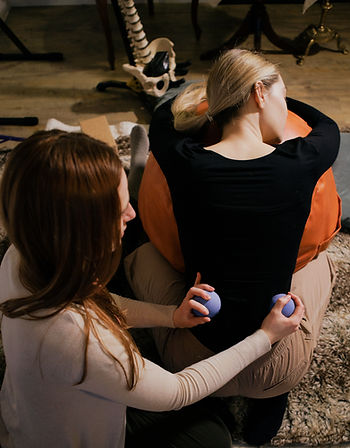
During the session, we did not focus on performing many exercises. Instead, we mapped our bodies and the breathing system within them. One of the most effective tools for this kind of somatic mapping is touch.
In contemporary Western culture, touch is largely confined to sexual or intimate relationships. Conscious, non-sexual touch is rare. As a result, touch is often perceived as threatening, and the body may respond by contracting or withdrawing. This response may be linked to traumatic experience, to learned beliefs that “the other is dangerous,” or simply to normal human awkwardness.
Trauma-Informed Practice and Power Dynamics
For this reason, I consider it essential to explicitly name the risks involved. Any somatic or embodied practice carries the potential for retraumatization, especially when physical contact is involved. Additionally, there is always an asymmetry of power in group settings: I am the facilitator, and participants are in a more vulnerable position.
A trauma-informed somatic practice requires continuous ethical attention. In my work, touch is used only within a clearly defined safe setting, with ongoing two-way communication and the explicit possibility to refuse without explanation. Touch is not treated as sacred or magical, but as a practical, grounded tool for perception and learning.
Kinesthetic awareness is a powerful human capacity. To develop it, we do need to do something with the body. But this work must unfold slowly, attentively, and with respect for personal boundaries — one’s own and those of others.
About an author:
Katsia Kaya is a Berlin-based somatic voice practitioner and artist working in person and online. She leads seminars and workshops across Europe, exploring embodiment, voice, and trauma-informed somatic practices.
Know more here


Comments